
How much space is actually inside that big shipping container? It’s a critical question. Whether you’re exporting goods for your business or moving your entire home, knowing the exact volume is the key to saving money and avoiding last-minute stress. Guessing isn’t an option when every cubic foot matters. Let’s know how to Calculate Shipping Container Volume. This guide will show you exactly how to find the answer.
Understanding the volume of a container is the key to managing shipping costs and operations, planning with your logistics partner, and ensuring everything fits perfectly and safely. Guessing can lead to costly mistakes and last-minute headaches.
Don’t worry, you don’t need to be a math genius to figure out this problem’s solution. In this guide, we’ll walk you through the simple steps to measure and calculate the volume of standard shipping containers in both CBM (Cubic Meters) and CFT (Cubic Feet).
Table of Contents
What’s the Difference Between CBM and CFT?
In the world of international shipping, you’ll constantly hear two terms:
- CBM (Cubic Meter): This is the global standard for measuring shipping volume. It’s calculated using meters.
- CFT (Cubic Feet): This unit is more common in the United States and for domestic purposes. It’s calculated using feet.
Knowing both is essential. For this guide, we’ll first calculate the volume in CBM (the industry standard) and then easily convert it to CFT.
Standard Shipping Container Dimensions
While containers might look the same, they come in a few standard sizes. The most important thing to remember is that we need the internal dimensions to calculate the usable space.
Here’s a handy chart of the typical internal dimensions for the most common container types:
| Container Type | Internal Length | Internal Width | Internal Height |
| 20ft Standard | 5.9 meters | 2.35 meters | 2.39 meters |
| 40ft Standard | 12.03 meters | 2.35 meters | 2.39 meters |
| 40ft High Cube (HC) | 12.03 meters | 2.35 meters | 2.70 meters |
Note: These dimensions can vary slightly between manufacturers, but this is a reliable average.
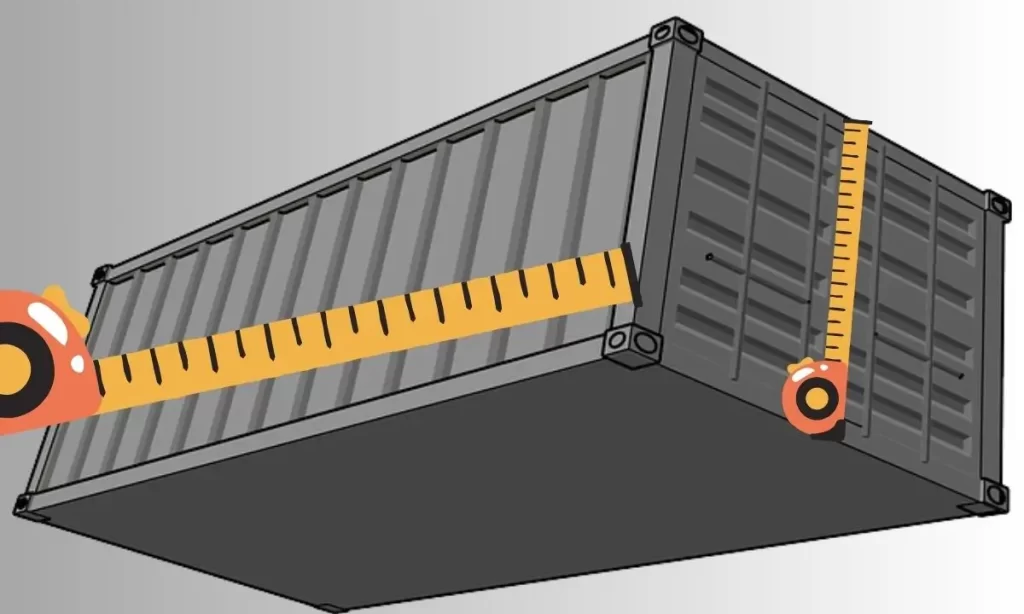
How to Calculate Container Volume in CBM (Step-by-Step)
Calculating the volume in Cubic Meters is incredibly straightforward.
The Formula:
CBM = Internal Length (m) × Internal Width (m) × Internal Height (m)
Let’s use our chart to calculate the volume for a 20ft standard container.
- Step 1: Find the dimensions: Length = 5.9 m, Width = 2.35 m, Height = 2.39 m.
- Step 2: Multiply the three numbers together.
CBM = 5.9 × 2.35 × 2.39 - Step 3: The Result:
CBM ≈ 33.1 Cubic Meters
So, a standard 20ft container has a usable volume of approximately 33.1 CBM.
How to Convert CBM to CFT (The Easy Way)
Now that you have the volume in CBM, converting it to Cubic Feet (CFT) is just one simple step.
The Conversion Formula:
1 CBM = 35.315 CFT
So, to convert our 20ft container’s volume to CFT:
CFT = 33.1 CBM × 35.315
CFT ≈ 1168.9 Cubic Feet
You Might Also Like
- How to Calculate CFT From Inches and Feet : In Just 3 Simple Steps
- How to Calculate Shipping Container Volume (A Guide for CFT & CBM)
- Wood CFT Calculation Formula: A Guide to Measuring Timber Volume
- How to Calculate CFT of a Round Log: 2 Easy Ways to Calculate CFT of a Round Log
- What is the Difference Between CFT and CBM?
- How to Calculate Sand in CFT: A Step by Step Guide and Solution
- What is Volumetric Weight in Shipping: Best Guide to Save Shipping Cost
- What is the Standard Unit for Measuring Wood? Beginner to Pro Instantly.
- The Importance of CFT in Logistics: Best Guide for Transporter and companies.
Let’s Make It Even Easier: Use a Calculator!
While the math is simple, it can be tedious. If you want to skip the manual calculations and get an instant, accurate answer, a reliable volume calculator is the way to go.
Our free online calculator can handle all these conversions for you in seconds.
Use This CFT Calculator
Frequently Asked Questions (FAQ)
Q1: What is the CBM of a 40ft container?
Using the same formula with the dimensions from our chart (12.03m × 2.35m × 2.39m), a standard 40ft container has a volume of approximately 67.6 CBM.
Q2: What is a High Cube (HC) container, and how is it different?
A High Cube container has the same length and width as a standard 40ft container, but it is about one foot taller. This extra height provides more vertical space, making its volume around 76.4 CBM.
Q3: Can I load goods up to the exact calculated volume?
Not quite. You should always leave some empty space for proper packing and air circulation. It’s a good practice to plan for using about 85-90% of the total volume.
Q: What is the best way to calculate shipping container volume?
A: While manual calculation is good to know, the fastest and most error-free method is to use a reliable online tool. Our shipping container volume calculator gives you instant answers in both CBM and CFT
Final Thoughts
Calculating the volume of a shipping container is a fundamental skill for anyone involved in logistics, moving, or global trade. By understanding the simple CBM and CFT formulas and knowing the standard container dimensions, you can plan your shipments with confidence, optimize your costs, and avoid surprises.
And when in doubt, remember that a good calculator is always your most reliable partner. Happy shipping




Pingback: What is Volumetric Weight in Shipping: Best Guide to Save Shipping Cost
Pingback: What is the Standard Unit for Measuring Wood?
Pingback: The Importance of CFT in Logistics