
Ever stared at a shipping quote or a construction plan and felt a little lost with terms like the difference between CFT and CBM? You’re not alone. These two acronyms are the standard language for measuring volume in logistics, shipping, and construction, but they represent two very different systems.
Understanding the difference isn’t just a technical detail—it’s crucial for accurate planning, budgeting, and avoiding costly mistakes.
In this simple guide, we’ll break down everything you need to know about CFT and CBM. We’ll explain what they are, how they differ, and most importantly, how to easily convert between them.
Table of Contents
What is CFT (Cubic Feet)?
Think of CFT as the language of the Imperial system.
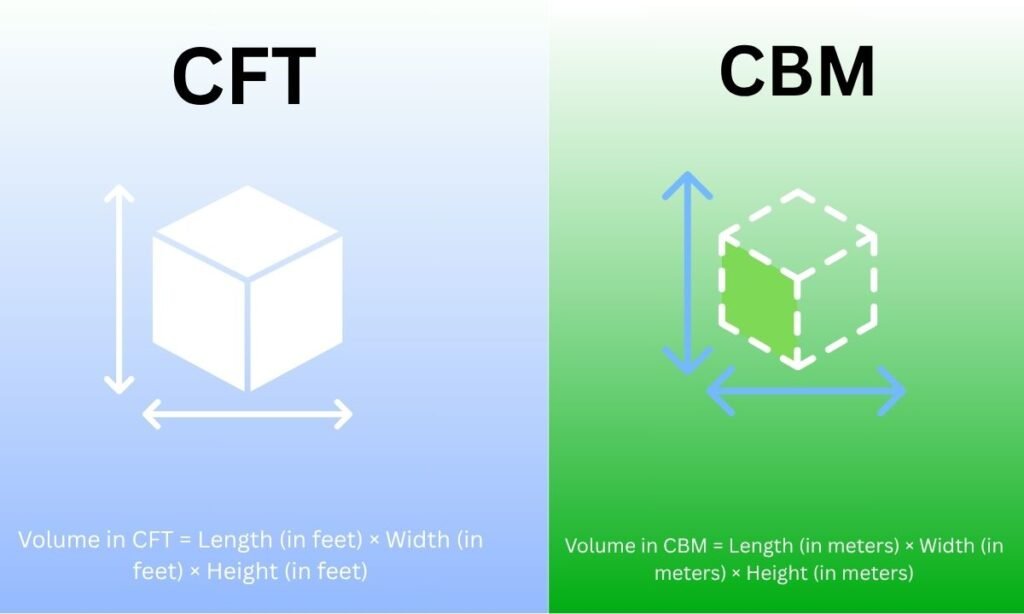
CFT stands for Cubic Feet. It’s the volume of a cube where each side is exactly one foot long. Imagine a standard small moving box—its volume would likely be measured in CFT.
The formula is straightforward:
Volume in CFT = Length (in feet) × Width (in feet) × Height (in feet)
CFT is primarily used in the United States for domestic purposes, like local shipping, measuring materials such as sand or gravel, and in the woodworking industry.
What is CBM (Cubic Meter)?
Now, think of CBM as the language of the Metric system—the system used by most of the world.
CBM stands for Cubic Meter. It’s the volume of a much larger cube where each side is one meter long. This is the global standard for measuring volume.
The formula is just as simple:
Volume in CBM = Length (in meters) × Width (in meters) × Height (in meters)
If you’re shipping anything internationally, whether by sea or air, CBM is the unit you’ll see. Freight companies, airlines, and international suppliers all use CBM to calculate shipping space and costs.
Key Differences: CFT vs. CBM at a Glance
Let’s put them side-by-side to see the main differences clearly:
| Basis of Comparison | CFT (Cubic Feet) | CBM (Cubic Meter) |
| Measurement System | Imperial System | Metric System |
| Relative Size | Smaller unit of volume | Much larger unit of volume |
| Geographical Use | Primarily in the USA | The global standard |
| Primary Application | Domestic shipping, local projects | International freight & logistics |
How to Easily Convert Difference Between CFT and CBM
This is where things get practical. When dealing with international suppliers or shipping, you’ll often need to convert between these two units. Luckily, all you need is one magic number.
The Magic Conversion Number: 1 CBM = 35.315 CFT
How to Convert CFT to CBM
To change Cubic Feet into Cubic Meters, you divide by the magic number.
Formula: CBM = Total CFT / 35.315
- Example: You have a shipment of 150 CFT.
- Calculation: 150 ÷ 35.315 = 4.247 CBM
How to Convert CBM to CFT
To change Cubic Meters into Cubic Feet, you multiply by the magic number.
Formula: CFT = Total CBM × 35.315
- Example: You have a shipment of 5 CBM.
- Calculation: 5 × 35.315 = 176.575 CFT
Are you still confused? Use our CFT Calculator Tool to get result in a second
Why This Matters for Your Wallet: The Role of Volumetric Weight
In the shipping world, space is money. If you have a large but very light package (like a box of foam pillows), it doesn’t weigh much, but it takes up a lot of valuable space in a truck or airplane.
This is why shipping companies use “volumetric weight.” They calculate a “weight” based on your package’s volume (CBM) and then charge you based on whichever is higher: the actual weight or the volumetric weight.
Understanding your shipment’s CBM is essential for accurately estimating costs and avoiding surprise charges.
You Might Also Like
- How to Calculate CFT From Inches and Feet : In Just 3 Simple Steps
- How to Calculate Shipping Container Volume (A Guide for CFT & CBM)
- Wood CFT Calculation Formula: A Guide to Measuring Timber Volume
- How to Calculate CFT of a Round Log: 2 Easy Ways to Calculate CFT of a Round Log
- What is the Difference Between CFT and CBM?
- How to Calculate Sand in CFT: A Step by Step Guide and Solution
- What is Volumetric Weight in Shipping: Best Guide to Save Shipping Cost
- What is the Standard Unit for Measuring Wood? Beginner to Pro Instantly.
- The Importance of CFT in Logistics: Best Guide for Transporter and companies.
Conclusion
In short, CFT and CBM are both vital units of volume. Just remember:
- CFT is for local use (think USA).
- CBM is for global use (think international shipping).
Knowing how to tell them apart and convert between them is a practical skill that will save you time, money, and headaches in any project involving logistics or commerce.
Frequently Asked Questions (FAQ)
Q1: Which is bigger, CFT or CBM?
A Cubic Meter (CBM) is much, much bigger. You can fit over 35 small one-foot boxes inside a single one-meter box! (1 CBM = 35.315 CFT).
Q2: Why is CBM the standard for international shipping?
Because most of the world uses the metric system for trade. Using one universal unit (CBM) simplifies calculations and creates a fair and consistent pricing system for everyone, no matter the country.
Q3: How do I find the CBM if my measurements are in inches or centimeters?
Easy! First, convert all your dimensions to meters, then multiply.
From Inches: (Length in inches × 0.0254) = Length in meters.
From Centimeters: (Length in cm ÷ 100) = Length in meters.
Once all three dimensions are in meters, just multiply them together to get the CBM.
Q4: Is there a quick way to estimate CBM from CFT?
Yes! For a rough mental estimate, just divide your CFT value by 35. For example, 100 CFT is roughly 3 CBM (100 ÷ 35 ≈ 2.85). It’s not exact, but it’s great for a quick check.
Q5: What is volumetric weight again?
It’s a pricing technique. Shipping companies calculate your package’s “volume weight” in CBM. You pay for whichever is greater: the actual weight (on a scale) or the volumetric weight (the space it takes up).





Pingback: How to Calculate CFT From Inches and Feet
Pingback: What is the Standard Unit for Measuring Wood?
Pingback: The Importance of CFT in Logistics