
Have you ever packed a large, lightweight box, and you’re shocked after seeing the shipping cost? Have you checked what is Volumetric Weight in Shipping? It’s light, but the bill tells a different story. If this sounds familiar, you’ve encountered the shipping industry’s best-kept secret: volumetric weight.
It’s the number one reason for unexpected shipping charges, but understanding it is the key to saving a lot of money.
In this article, we’ll pull back the curtain on volumetric weight (also known as dimensional weight). We’ll explain what it is, why it exists, and most importantly, how you can calculate it to plan your shipments like a pro.
Table of Contents
What is Volumetric Weight? Exactly
Think of it this way: what takes up more space in a delivery truck?
- A 10 kg box of fluffy pillows.
- A 10 kg box of small steel balls.
The pillows, right? Even though they weigh the same, the pillow box occupies much more valuable space.
Volumetric weight is simply a pricing method used by shipping companies (like DHL, FedEx, and UPS) to charge you for the space your package takes up, rather than its actual weight. It’s a way to ensure that large, lightweight items are billed fairly compared to small, heavy ones.
Why Do Shipping Companies Use It?
Space is the most valuable asset for a shipping (Logistics) company. A delivery aeroplane or a truck has a limited amount of space. If they only charged by actual weight, their trucks would be filled with bulky, lightweight items, and they would lose lots of money.
By using a pricing method called dimensional weight, they can account for the volume of each package, creating a fairer system for all types of cargo.
How to Calculate Volumetric Weight (The Formula)
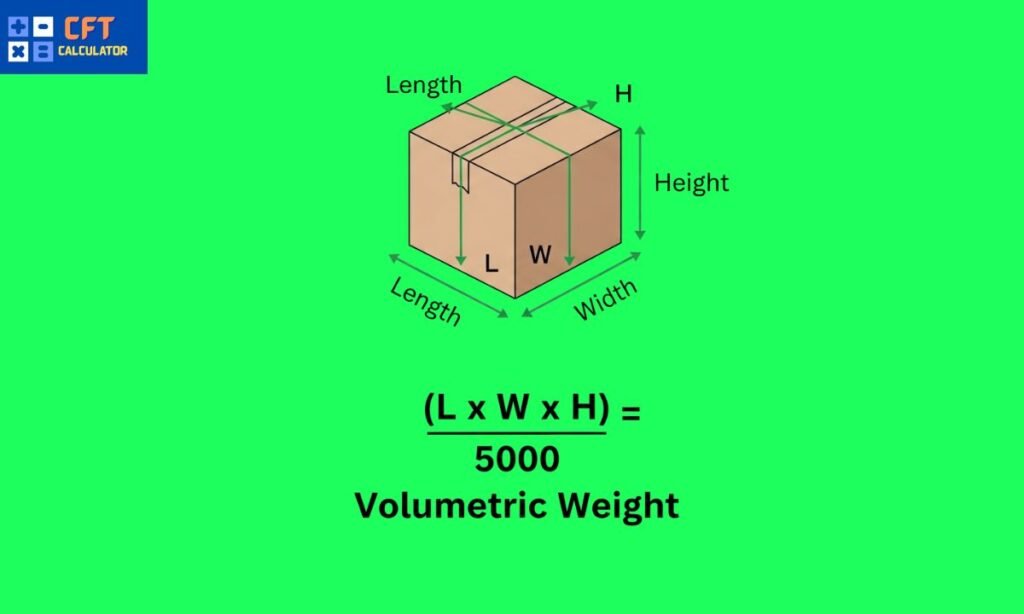
Calculating volumetric weight is easier than you think. You just need three things: your package’s length, width, and height, and a special number called a “DIM Divisor.”
The Universal Formula (Metric System – CBM):
This is the standard formula used for international shipping.
Volumetric Weight (in kg) = (Length (cm) × Width (cm) × Height (cm)) / 5000
The Formula (Imperial System – CFT):
This is often used for domestic shipping within the US.
Volumetric Weight (in lbs) = (Length (in) × Width (in) × Height (in)) / 139
Important Note: The DIM Divisor (5000 or 139) can sometimes vary depending on the shipping company and the service you choose. Always check with your courier for their exact divisor.
Let’s Walk Through an Example:
Imagine you have a box with these dimensions:
- Length = 60 cm
- Width = 40 cm
- Height = 50 cm
- Actual Weight = 15 kg
Step 1: Calculate the Volume in cm³
60 × 40 × 50 = 120,000 cm³
Step 2: Apply the Formula
Volumetric Weight = 120,000 / 5000 = 24 kg
Actual Weight vs. Volumetric Weight: Which One Do You Pay For?
This is the most important part. The shipping company will calculate both the actual weight (what the scale says) and the volumetric weight. You will be charged based on whichever is greater. This is called the “Chargeable Weight.”
In our example:
- Actual Weight = 15 kg
- Volumetric Weight = 24 kg
Since the volumetric weight (24 kg) is greater, you will be billed for 24 kg, not 15 kg.
Tips to Reduce Your Volumetric Weight and Save Money
- Use the Right-Sized Box: Don’t use a huge box for a small item. The less empty space, the smaller the dimensions, and the lower the volumetric weight.
- Compress Your Items: For items like clothing or bedding, use vacuum-sealed bags to reduce their volume significantly.
- Disassemble Items: If possible, take larger items apart so they can fit into a smaller box.
- Use Poly Mailers for Soft Goods: For non-fragile items like t-shirts, a poly mailer bag has much less volume than a box.
You Might Also Like
- How to Calculate CFT From Inches and Feet : In Just 3 Simple Steps
- How to Calculate Shipping Container Volume (A Guide for CFT & CBM)
- Wood CFT Calculation Formula: A Guide to Measuring Timber Volume
- How to Calculate CFT of a Round Log: 2 Easy Ways to Calculate CFT of a Round Log
- What is the Difference Between CFT and CBM?
- How to Calculate Sand in CFT: A Step by Step Guide and Solution
The Easiest Way: Use Our Free Calculator!
Want to skip the math? Our free Volumetric Weight Calculator or CFT Calculator does all the work for you. Just enter the dimensions, and it will instantly tell you the volumetric weight, so you can plan and budget with confidence.
Frequently Asked Questions (FAQ)
Q1: Is dimensional weight the same as volumetric weight?
Yes, they are just two different names for the same thing. “Dimensional weight” is more common in the US, while “volumetric weight” is used more internationally.
Q2: Does this apply to all packages?
Mostly, yes. It applies to almost all domestic and international courier and air freight services. Some services might have a size limit below which they don’t apply this rule, but it’s best to assume they do.
Q3: How is CBM related to volumetric weight?
They are closely related! To calculate volumetric weight, you first need to find the volume of your package. CBM (Cubic Meter) is the standard unit of volume for this. If you want to understand CBM better, check out our guide on the difference between CFT and CBM
Q4: What is a DIM Divisor?
The DIM Divisor is the number set by courier companies to convert a package’s volume into its volumetric weight. The most common divisor is 5000 for metric calculations.
Final Thoughts
Understanding volumetric weight is like learning the secret language of the shipping industry. It empowers you to pack smarter, choose the right packaging, and accurately estimate your shipping costs. By paying attention to the size of your packages, not just their weight, you can avoid surprises and keep your shipping budget under control.



Pingback: What is the Standard Unit for Measuring Wood?