
Concrete columns are one of the most important structural components in construction. They support beams, slabs, and the overall load of a building. Before starting any construction project, it is essential to calculate the exact amount of concrete required for the columns.
Accurate concrete calculation helps contractors, engineers, and homeowners avoid material shortages, reduce waste, and manage project costs efficiently.
In this guide, you will learn how to calculate concrete for columns step-by-step, including the formula, examples, and tips used by construction professionals.

Table of Contents
What Is a Concrete Column?
A concrete column is a vertical structural element designed to transfer the load of a building from beams and slabs down to the foundation.
Columns are commonly used in:
- Residential houses
- Commercial buildings
- Bridges and infrastructure
- Multi-story structures
Columns are typically reinforced with steel bars (rebar) and filled with concrete to provide strength and durability.
Why Concrete Calculation Is Important
Before pouring concrete, builders must estimate how much concrete will be required. Proper calculation offers several benefits.
Prevents Material Shortage
If you underestimate the required concrete volume, construction work may stop until additional materials arrive.
Reduces Material Waste
Overestimating concrete volume leads to extra cost and unnecessary waste.
Helps With Budget Planning
Accurate calculations allow builders to plan the construction budget effectively.
Improves Construction Efficiency
When the required materials are prepared in advance, construction progresses smoothly without delays.
Concrete Column Volume Formula
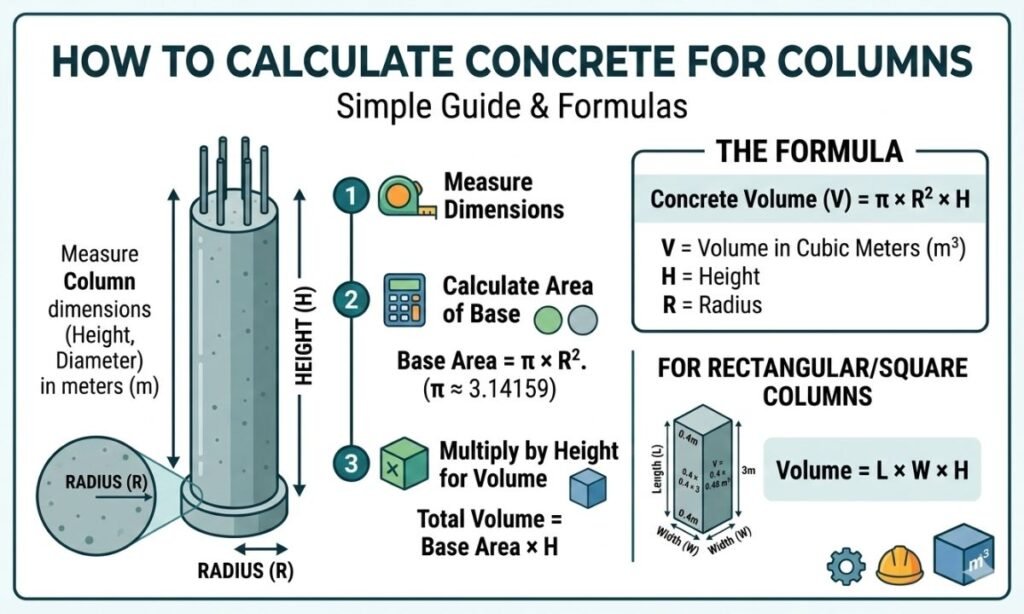
The concrete volume of a rectangular column can be calculated using a simple mathematical formula.
Formula
Concrete Volume = Length × Width × Height
Where:
- Length = Column length
- Width = Column width
- Height = Column height
The result gives the concrete volume in cubic units.
For example:
If all measurements are in feet, the result will be in cubic feet (CFT).
Step-by-Step Method to Calculate Concrete for Columns
Follow these simple steps to calculate concrete volume.
Step 1: Measure Column Dimensions
First, measure the three main dimensions of the column:
- Length
- Width
- Height
Example measurements:
- Length = 1.5 ft
- Width = 1.5 ft
- Height = 10 ft
Make sure all measurements use the same unit system.
Step 2: Apply the Concrete Formula
Now apply the formula:
Concrete Volume = Length × Width × Height
Example calculation:
1.5 × 1.5 × 10
Concrete Volume = 22.5 cubic feet
Step 3: Convert Units (If Required)
Construction projects may use different units such as:
- Cubic Feet (CFT)
- Cubic Meter (CBM)
- Cubic Yard
Common conversions:
1 Cubic Meter = 35.3147 Cubic Feet
1 Cubic Yard = 27 Cubic Feet
These conversions help builders work with international measurement standards.
Example Concrete Column Calculation
Let’s look at a real construction example.
Example
Column dimensions:
- Length = 2 ft
- Width = 2 ft
- Height = 12 ft
Calculation:
2 × 2 × 12 = 48 cubic feet
Converted values:
- 48 CFT
- 1.36 Cubic Meter
- 1.78 Cubic Yard
This means you will need approximately 48 cubic feet of concrete to build this column.
You Might Also Like
- What is CBM Calculator: The Secret to Cutting Your Shipping Costs
- How to Calculate CFT From Inches and Feet : In Just 3 Simple Steps
- How to Calculate Shipping Container Volume (A Guide for CFT & CBM)
- Wood CFT Calculation Formula: A Guide to Measuring Timber Volume
- How to Calculate CFT of a Round Log: 2 Easy Ways to Calculate CFT of a Round Log
- What is the Difference Between CFT and CBM?
- How to Calculate Sand in CFT: A Step by Step Guide and Solution
- What is Volumetric Weight in Shipping: Best Guide to Save Shipping Cost
- What is the Standard Unit for Measuring Wood? Beginner to Pro Instantly.
- The Importance of CFT in Logistics: Best Guide for Transporter and companies.
- How to Calculate CFT of Concrete for Slab (Step-by-Step Guide with Example)
- How to Calculate Concrete for Footings(Easy Guide + Formula)
How Many Concrete Bags Are Needed?
Calculate Concrete for Columns is often purchased in bags. The number of bags required depends on the concrete mix and bag size.
For example:
A 50 kg cement bag typically produces around 1.25 cubic feet of concrete.
Using the earlier example:
Concrete required = 48 CFT
Number of bags required:
48 ÷ 1.25 = 38 to 40 bags (approx.)
Builders usually add 5–10% extra material to cover waste and spillage.
Common Column Shapes
Different types of columns are used in construction.
Rectangular Column
Most common type used in residential buildings.
Square Column
Often used in modern building designs.
Circular Column
Common in bridges and large infrastructure projects.
Each column shape requires a slightly different calculation formula.
Tips for Accurate Concrete Estimation
To ensure the most accurate calculation, consider these professional tips.
Always Double-Check Measurements
Incorrect measurements can lead to large errors in material estimation.
Use the Same Unit System
Mixing units like feet and meters can cause incorrect calculations.
Add Extra Concrete Allowance
Builders typically add 5–10% extra concrete to handle waste.
Use Online Construction Tools
Online calculators can quickly calculate volume and convert units automatically.
You can easily estimate column concrete using this tool: Column Concrete Calculator on CFT Calculator
When Should You Calculate Concrete Volume?
Concrete estimation should be done during the construction planning stage.
Typical stages include:
- Before ordering concrete materials
- During structural planning
- While preparing construction budgets
- Before pouring concrete
Early calculation helps avoid costly mistakes during construction.
Conclusion
Calculate Concrete for Column is an essential step in any construction project. Accurate estimation ensures that you have the right amount of materials while avoiding unnecessary costs and delays.
By using the simple formula Length × Width × Height, builders can quickly estimate the required concrete volume. However, online tools make the process even easier and faster.
If you want to simplify the calculation process, try the Column Concrete Calculator available on CFT Calculator. It instantly calculates the required concrete volume in multiple units, saving time and improving accuracy.
Use Our Calculators
Frequently Asked Questions (FAQ)
How do you calculate concrete for a column?
Concrete for a column is calculated using the formula:
Length × Width × Height
The result gives the total concrete volume required.
What unit is used for concrete calculation?
Concrete volume is commonly measured in:
Cubic Feet (CFT)
Cubic Meter (CBM)
Cubic Yard
How much extra concrete should be added?
Most construction professionals add 5–10% extra concrete to cover waste and spillage.
Can this method be used for circular columns?
No. Circular columns require a different formula using the π (pi) value