
Ever started a construction project and found yourself staring at a pile of sand, wondering, “Is this enough?” Or maybe you’re about to order sand for the first time and have no idea how much to ask for. Don’t worry, we are here to help you! Knowing how to calculate the right amount of sand is crucial to save money and avoid last-minute headaches.
The key to solving this puzzle is simple: CFT (Cubic Feet).
In this guide, we’ll walk you through everything you need to know about how to calculate sand in CFT. We’ll cover the basic formulas, tackle common real-world questions (like converting tons to CFT), and show you how an online calculator can be your best friend.
Table of Contents
The Basic CFT Formula
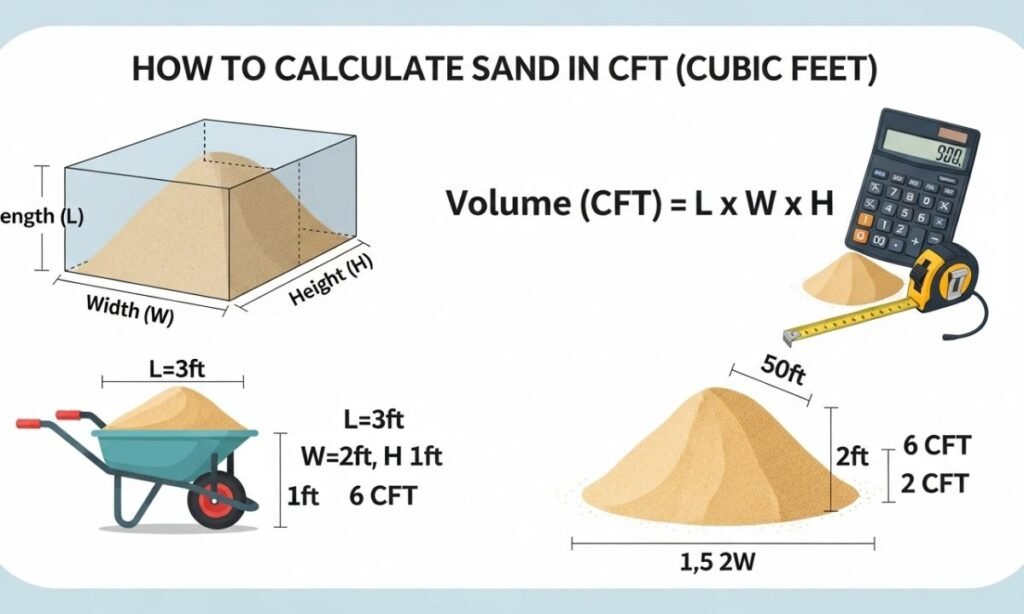
Let’s start with the simplest scenario. If you need to fill a rectangular space like a sandbox, a foundation pit, or a garden bed, the formula is straightforward multiplication.
The only rule? Measure everything in feet.
Sand CFT Formula = Length (ft) × Width (ft) × Height (ft)
A Quick Example:
Imagine you’re building a sandbox for your kids.
- It’s 5 feet long.
- It’s 4 feet wide.
- You want to fill it with sand up to a height of 1 foot.
Calculation:
CFT = 5 ft × 4 ft × 1 ft = 20 CFT
It’s that simple! You need 20 Cubic Feet of sand.
Converting Tons of Sand to CFT
Here’s where most people get stuck. We usually buy sand by weight (in tons or kg), but we use it by volume (in CFT). How do you connect the two?
The secret is density. The density of sand simply tells us how much a certain volume of it weighs. This can change depending on whether the sand is dry or wet.
The Golden Numbers:
- 1 Ton of Dry Sand is roughly 22 CFT.
- 1 Ton of Wet Sand is roughly 18.4 CFT.
Why the difference? Wet sand has water trapped in it, making it heavier. So, for the same weight, you get less volume (fewer CFT).
Sand in Trucks and Tractors
How much sand is in a truck?
A standard dump truck can hold anywhere from 280 to 560 CFT of sand, depending on its size. A smaller truck usually holds around 300 CFT. It’s always a good idea to ask your supplier about the truck’s capacity.
How much sand is in a tractor trolley?
A typical tractor trolley, commonly used for local deliveries, holds about 80 to 120 CFT of sand.
An Expert Tip: The “Bulking” of Sand
Here’s a fun fact that can save you money! When you add a little water to dry sand, its volume actually increases. This is called bulking. The water pushes the sand particles apart, making them take up more space.
This is important because if you order sand by volume (CFT) and it’s damp, you might be getting less actual sand than you think. This is another reason why knowing the weight-to-volume conversion is so useful!
You Might Also Like
- How to Calculate CFT From Inches and Feet : In Just 3 Simple Steps
- How to Calculate Shipping Container Volume (A Guide for CFT & CBM)
- Wood CFT Calculation Formula: A Guide to Measuring Timber Volume
- How to Calculate CFT of a Round Log: 2 Easy Ways to Calculate CFT of a Round Log
- What is the Difference Between CFT and CBM?
- How to Calculate Sand in CFT: A Step by Step Guide and Solution
- What is Volumetric Weight in Shipping: Best Guide to Save Shipping Cost
- What is the Standard Unit for Measuring Wood? Beginner to Pro Instantly.
- The Importance of CFT in Logistics: Best Guide for Transporter and companies.
The Easiest Way? Use a Calculator!
Tired of doing the math? We get it. Our free Sand CFT Calculator is built to do all the heavy lifting for you. Just enter the dimensions or the weight, and it will give you the exact CFT you need in seconds.
Frequently Asked Questions (FAQ)
Q1: What is the main formula to calculate sand CFT?
For any rectangular area, the formula is simply Length (ft) × Width (ft) × Height (ft).
Q2: Is 1 ton of sand the same as 1 CBM?
No, they are very different. 1 ton of sand is much less than 1 CBM in volume. CBM is a metric unit, and if you’d like to learn more, you can read our simple guide on the difference between CFT and CBM.
Q3: What does “brass” of sand mean?
“Brass” is a unit of volume often used in India. Simply put, 1 Brass = 100 Cubic Feet (CFT).
Q4: Should I buy dry sand or wet sand?
Dry sand is usually the better choice. You get more volume for the same weight, and its properties are more consistent for high-quality construction projects.
Final Thoughts
Calculating the right amount of sand doesn’t have to be a guessing game. By understanding the basic CFT formula and knowing how to handle real-world conversions, you can plan your projects like a pro. And when in doubt, remember that a reliable online calculator is always there to help.




Pingback: What is the Standard Unit for Measuring Wood?
Pingback: How to Calculate CFT From Inches and Feet