
Ever walked into a timber yard or looked at a logging truck and felt a little lost? and you never hear about Standard Unit for Measuring Wood You hear terms like “Board Foot,” “Cubic Foot,” “Cubic Meter,” and “Cord” thrown around, and it can feel like everyone is speaking a different language.
Here’s the simple, honest answer: there isn’t just one! The “standard” unit completely depends on two things:
- What form the wood is in (Is it a neat plank of lumber, a rough log, or firewood?)
- Where are you in the world?
But don’t worry! In this guide, we’ll unravel this puzzle together. We’ll break down the most common units in simple, conversational language so you’ll know exactly what you’re dealing with, every time.
Table of Contents
Why Are There So Many Different Units?
Wood is used in many different forms, and each form has a measurement that makes the most sense for it. You wouldn’t measure a liquid like milk in kilograms, right? Similarly, you wouldn’t measure a pile of firewood the same way you measure a perfect, smooth plank of oak.
Here are the main units you need to know.
1. The Board Foot (BF or BFT) – The King of Lumber
If you are in North America (USA and Canada) and buying lumber (processed planks, boards), the Board Foot is the undisputed king. It’s the standard unit for almost all hardwood and softwood lumber.
What is a Board Foot?
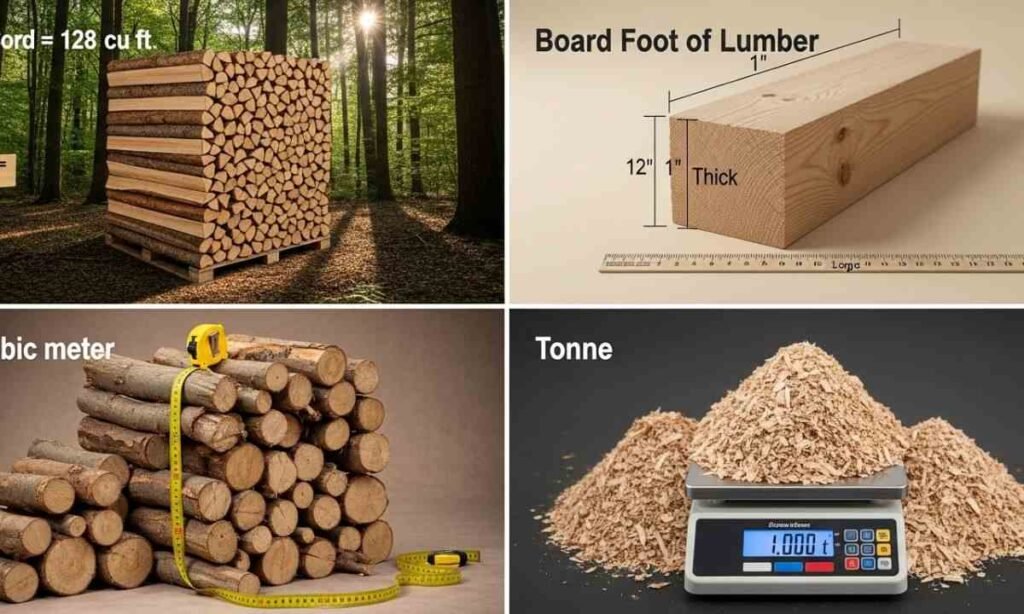
A board foot is a measure of volume. One board foot is the volume of a piece of wood that is:
- 1 foot (12 inches) long
- 1 foot (12 inches) wide
- 1 inch thick
The Simple Formula:
Board Feet = [Length (in) × Width (in) × Thickness (in)] / 144
Example:
Imagine a plank of wood that is 6 feet long (72 inches), 6 inches wide, and 2 inches thick.
Board Feet = (72 × 6 × 2) / 144 = 6 Board Feet
2. The Cubic Foot (CFT) – For General Volume & Logs
The Cubic Foot is a more universal measure of volume that you’ll see used for a wider variety of wood forms, especially rough logs or large timber beams.
What is a Cubic Foot?
As we’ve discussed in our other guides, a cubic foot is the space inside a box that is 1 foot x 1 foot x 1 foot. For wood, it’s used to get a sense of the total raw volume. If you want to dive deeper, you can learn all about the wood CFT calculation in our detailed guide.
The Simple Formula:
CFT = Length (ft) × Width (ft) × Height (ft)
CFT is very common in many parts of the world, including India, for calculating the volume of raw timber logs.
3. The Cubic Meter (CBM) – The Global Standard
When wood is bought and sold on the international market, everything switches to the metric system. The Cubic Meter (CBM) is the standard unit for the global timber trade.
What is a Cubic Meter?
It’s the volume of a cube that is 1 meter x 1 meter x 1 meter. Since a meter is much larger than a foot, 1 CBM is a lot more wood than 1 CFT. (In fact, 1 CBM ≈ 35.3 CFT).
If you’re dealing with international shipping, understanding the difference between CFT and CBM is crucial.
4. The Cord – Just for Firewood
Have you ever seen firewood stacked neatly in a pile? That’s often measured in Cords. A cord is a standard measure of stacked firewood to ensure a fair sale.
What is a Full Cord?
A “Full Cord” is a neatly stacked pile of wood that measures:
- 4 feet high
- 4 feet wide
- 8 feet long
This equals a total volume of 128 cubic feet.
Be careful of the term “Face Cord,” which is also 4 feet high and 8 feet long, but its width is only the length of one piece of firewood (usually 16 inches), so it’s much less wood than a full cord.
So, Which Unit Should You Use?
- Buying finished lumber in the US? Think in Board Feet.
- Calculating the raw volume of a log? Use our guide on how to calculate CFT of a round log.
- Importing or exporting timber? Everything will be in Cubic Meters.
- Buying a winter’s supply of firewood? Ask for it in Cords.
You Might Also Like
- How to Calculate CFT From Inches and Feet : In Just 3 Simple Steps
- How to Calculate Shipping Container Volume (A Guide for CFT & CBM)
- Wood CFT Calculation Formula: A Guide to Measuring Timber Volume
- How to Calculate CFT of a Round Log: 2 Easy Ways to Calculate CFT of a Round Log
- What is the Difference Between CFT and CBM?
- How to Calculate Sand in CFT: A Step by Step Guide and Solution
- What is Volumetric Weight in Shipping: Best Guide to Save Shipping Cost
- What is the Standard Unit for Measuring Wood? Beginner to Pro Instantly.
- The Importance of CFT in Logistics: Best Guide for Transporter and companies.
Frequently Asked Questions (FAQ)
Q1: What is the most common standard unit for wood?
It truly depends. In the U.S. lumber industry, it’s the Board Foot. For international trade, it’s the Cubic Meter. For raw logs in many regions, it’s the Cubic Foot
Q2: How many board feet are in a cubic foot?
This is a great question! Since 1 cubic foot is 12 inches deep and a board foot is only 1 inch deep, 1 Cubic Foot (CFT) = 12 Board Feet (BF).
Q3: Why don’t people just sell wood by weight (kg or tons)?
Because the weight of wood changes dramatically based on its water content. A freshly cut “green” log can be almost twice as heavy as the same log after it has been dried. Using volume is a much more consistent and fair way to measure the actual amount of wood fiber you are buying.
Q4: Is a “rick” of wood the same as a cord?
The term “rick” is less standardised and can be confusing. It usually refers to a “Face Cord,” but its size can vary by region. It’s always better to clarify and ask for the measurements in feet
Conclusion
So, while there’s no single “one-size-fits-all” standard for measuring wood, it’s not as complicated as it first seems. The key is to understand the context. Once you know if you’re dealing with finished lumber, a raw log, or firewood, you’ll know exactly which unit of measurement to use.




Wonderful blog! I found it while browsing on Yahoo News.
Do you have any tips on how to get listed in Yahoo News?
I’ve been trying for a while but I never seem to get there!
Cheers
Pingback: How to Calculate CFT From Inches and Feet